
A few minutes are enough for Caroline Bachmann to make a pencil sketch on an A4 sheet. From her window, day and night, she captures brief signs she perceives from the landscape. She then works on canvases toned with sienna, which must dry before other colours can be added. This is the stage where contrasts are established and an almost artificial luminescence emerges, as do the “tensions, harmonies and echoes in the painting”, to use her own words.
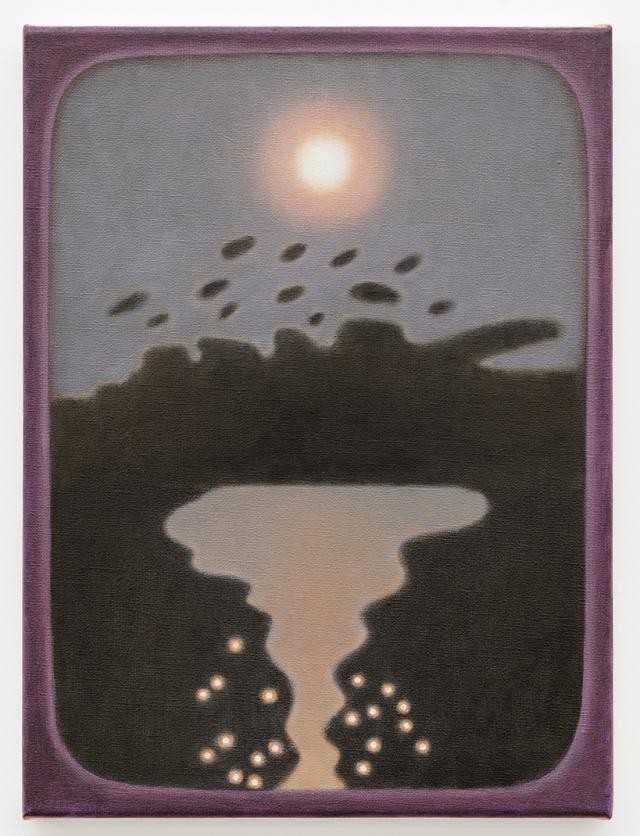
Lune Brume Reflet is no exception. We are still at the same location, although Caroline Bachmann never paints in front of the landscape, instead working in a studio without a view, guided by a sense of self-evidence. With very thin strokes imperceptibly overlapping on the canvas, she composes her motif exclusively with natural elements. There are no boats or houses depicted, no human or animal life to be seen.
“What interests me is the lake’s horizontal, flat, mirror-like surface, the verticality of the mountains, and the third dimension of the sky with the clouds and stars.” She always surrounds these elements with a trompe-l’oeil frame painted right on the canvas—an illusionistic device borrowed from the paintings of Louis Michel Eilshemius.
Lune Brume Reflet is no exception. We are still at the same location, although Caroline Bachmann never paints in front of the landscape, instead working in a studio without a view, guided by a sense of self-evidence. With very thin strokes imperceptibly overlapping on the canvas, she composes her motif exclusively with natural elements. There are no boats or houses depicted, no human or animal life to be seen.
“What interests me is the lake’s horizontal, flat, mirror-like surface, the verticality of the mountains, and the third dimension of the sky with the clouds and stars.” She always surrounds these elements with a trompe-l’oeil frame painted right on the canvas—an illusionistic device borrowed from the paintings of Louis Michel Eilshemius.