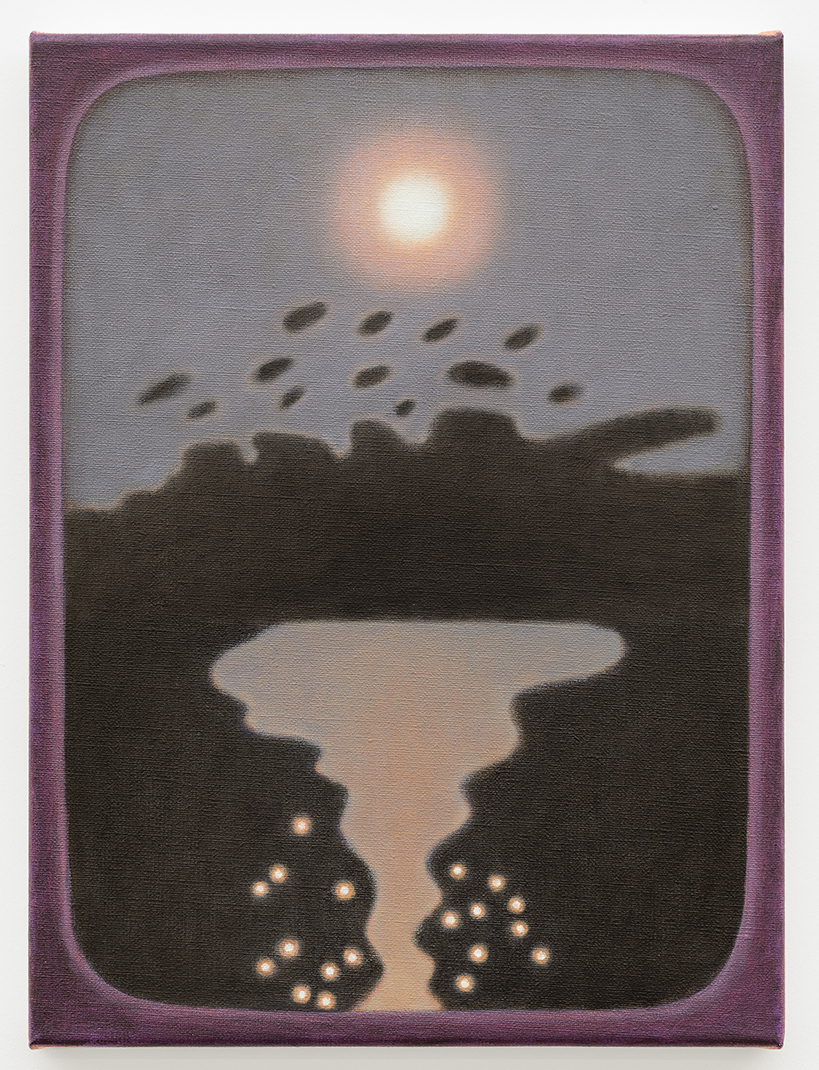

After studying graphic design in the 1980s at Geneva’s École des arts décoratifs, Caroline Bachmann moved to Barcelona, where she worked in her first profession for five years before relocating to Rome. She remained in the Italian capital for twelve years, exploring the country’s heritage by visiting churches, monuments and exhibitions. It was also in Rome that she embarked on a self-taught artistic practice, initially focusing on photography and performance.
In 2013, Caroline Bachmann revived her practice with oil paint and water-based paint, influenced by American artist Louis Michel Eilshemius. “I wanted to question the human being’s place in the world, question what we are: our fears, our aspirations […]. I’ve never viewed art as an individual form of expression.” Working extremely slowly, spending months on each of her paintings, she waits for boredom to set in, so to speak: “That’s how I found my way into poetry and spirituality.”
The view of the lake from her window is her only motif—one she never tires of. It is constantly renewed under the effects of the seasons, as she translates it into timeless, dreamlike visions through synthetic forms, simplified to an extreme: “What triggers the act of painting is a physical sensation and a light. Lighting conditions are linked to particular atmospheric circumstances”, explains the winner of the 2022 Grand Prix suisse d’art / Prix Meret Oppenheim.
In 2013, Caroline Bachmann revived her practice with oil paint and water-based paint, influenced by American artist Louis Michel Eilshemius. “I wanted to question the human being’s place in the world, question what we are: our fears, our aspirations […]. I’ve never viewed art as an individual form of expression.” Working extremely slowly, spending months on each of her paintings, she waits for boredom to set in, so to speak: “That’s how I found my way into poetry and spirituality.”
The view of the lake from her window is her only motif—one she never tires of. It is constantly renewed under the effects of the seasons, as she translates it into timeless, dreamlike visions through synthetic forms, simplified to an extreme: “What triggers the act of painting is a physical sensation and a light. Lighting conditions are linked to particular atmospheric circumstances”, explains the winner of the 2022 Grand Prix suisse d’art / Prix Meret Oppenheim.